Jumper's Knee Physiotherapy in Kitsilano, Vancouver
Treatment for pain just below the kneecap that flares with jumping, landing, stairs and hills, known clinically as patellar tendinopathy.
Clinically reviewed by Charles Sutton, Registered Physiotherapist, November 2026
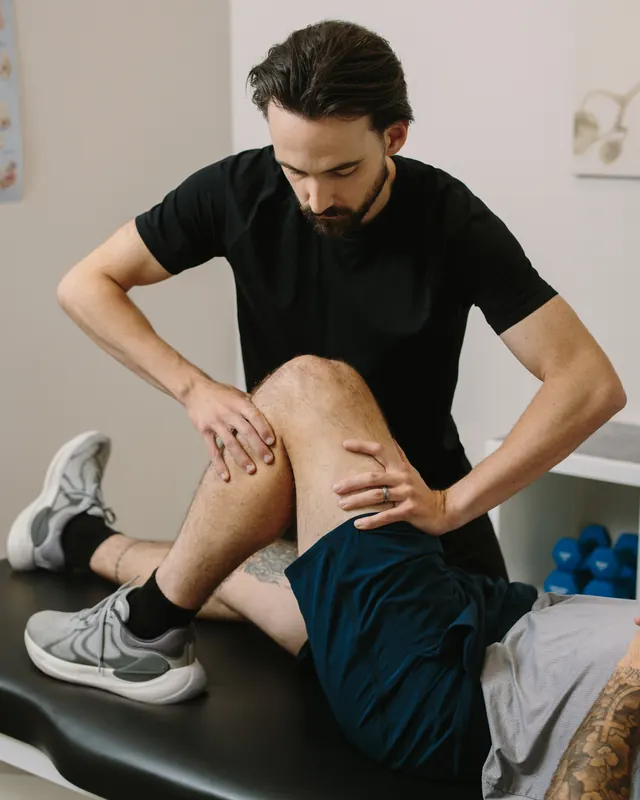
What jumper's knee physiotherapy involves
Jumper's knee is an overload problem in the patellar tendon, which runs from the bottom of the kneecap to the shin. It usually hurts at one spot just below the kneecap when you jump, land, squat or take the stairs. It's common in jumping sports and in runners who add hills or speed, but you don't need to play a sport to get it: more stairs, squats, hiking or gym work can bring it on too. Tendons recover by getting stronger, not by resting until the pain fades, so your physiotherapist adjusts the activities that flare it, then builds tendon strength in steps for the stairs, hills or jumps you want back. Hands-on treatment and IMS can ease pain along the way.
Tendon or kneecap?
Pain at one spot below the kneecap points to the tendon. Pain spread around or behind the kneecap fits runner's knee better. We test for both, because the plans differ.
Settling the pain
Holding a position under load, such as a wall sit, can ease tendon pain for some people. We use it to keep you training while the tendon settles.
Heavy, slow strength
Slow, heavy leg strength work over several weeks is the core of treatment. We set the load so the tendon is challenged but settled again by the next morning.
Spring and landing
Once the strength is there, we add the springy work your sport demands: skipping, hopping, then jumping and landing, built up in steps.
Your training week
We look at how often you jump, run hills or train hard, and spread the heaviest sessions so the tendon recovers between them.
Shockwave therapy
Your physiotherapist will discuss shockwave therapy alongside your strength program if it's appropriate. It supports the loading work rather than replacing it.
Common reasons people come in
Pain landing from a jump
A sharp spot below the kneecap as you land, take off or change direction, in sport, at the gym or on the trail.
Pain that warms up, then returns
Pain at the start of training that eases once you're warm, then comes back worse that evening or the next morning.
Stairs, squats and lunges
A sore spot below the kneecap going down stairs, or in a deep squat or lunge.
Hills and speed work
Tendon pain that started when you added hill repeats, track sessions or jump training.
Questions about jumper's knee
What is jumper's knee, and why does it hurt?
Jumper's knee, or patellar tendinopathy, is a load problem in the tendon below the kneecap. The patellar tendon stores and releases energy like a spring each time you jump, land or run, and it becomes painful when that load rises faster than the tendon can adapt. Easing off painful activity can settle the pain, but the tendon then needs to be strengthened back to the level your sport asks of it.
Is it jumper's knee or runner's knee?
Jumper's knee hurts in the tendon, at one spot just below the kneecap that you can usually point to with a finger. Runner's knee hurts around or behind the kneecap and is harder to pin down. Both can flare with squats and stairs, so we test them separately. In teenagers, pain at the bony bump below the knee may be Osgood-Schlatter disease, a common problem in growing athletes that we also assess and treat.
Should I stop jumping or running?
Usually not completely. Complete rest weakens the tendon, and the pain often returns when you go back. We'll help you trim the sessions that flare it and keep the ones it tolerates, using a simple guide: mild discomfort during exercise is fine if it settles by the next morning and the tendon isn't more sore than the day before.
How long does jumper's knee take to get better?
Tendons adapt slowly. Most people need at least three months of consistent strength work, and pain that has been there for a long time can take longer. Pain often eases before the tendon is ready for full jumping, so we progress by what your knee can do, not only by how it feels.
Do I need a scan or an injection?
Most people need neither to start. Jumper's knee is diagnosed by examination, and scans often show tendon changes in people with no pain at all. Cortisone injections around the patellar tendon may ease pain for a short time but can weaken the tendon, so they're generally avoided. If your recovery stalls despite a good program, or something in the examination doesn't fit, we'll point you to your doctor and share our findings.
When can I get back to full training and games?
Once you can do your strength work, hop and land on that leg without the tendon flaring the next day, we build your sport back in steps: drills, then full training, then games. We'll agree the steps with you, and with your coach if you'd like.
When to get medical help
Go to an emergency department right away if your knee quickly becomes hot, swollen and very painful to move, even without a fever, or if you can't put weight on the leg after an injury or fall.
See a doctor or go to urgent care the same day after a sudden pop below the kneecap if straightening your knee is newly weak or difficult, or the knee gives way when you stand. The tendon may have torn.
See a doctor today for new pain or swelling in one calf that you can't explain, especially if it feels warm or tender. Call 911 for sudden shortness of breath, chest pain or coughing up blood.
Not sure if it's urgent? Call HealthLink BC at 8-1-1 to speak with a nurse, day or night.
Who you'll see: one of our physiotherapists, in a one-on-one physiotherapy appointment. We bill this visit as physiotherapy, and most, if not all, extended health plans cover at least some physiotherapy. We direct bill most major insurers.
Which appointment fits: A regular physiotherapy visit fits jumper's knee best, whatever brings it on. If running is what brings it on, a running assessment can take a closer look at your training and how you run. It runs 60 minutes, costs $185, and is with Charles or Al. It adds slow motion video filmed from the side and behind on your own phone, strength and movement testing, and a training and footwear review.
Often connected to: runner's knee, knee pain and field sports. Related services: Sports Injury Physiotherapy and Kinesiology.
Book an assessment
Choose your appointment and book online. What to expect at your first visit
Book now