Physiotherapy for Dancers in Kitsilano, Vancouver
Dance asks for strength at extreme ranges of motion, precise foot control, sustained turnout and balance, repeated for hours. Recovering from a dance injury calls for treatment and rehabilitation built around those demands.
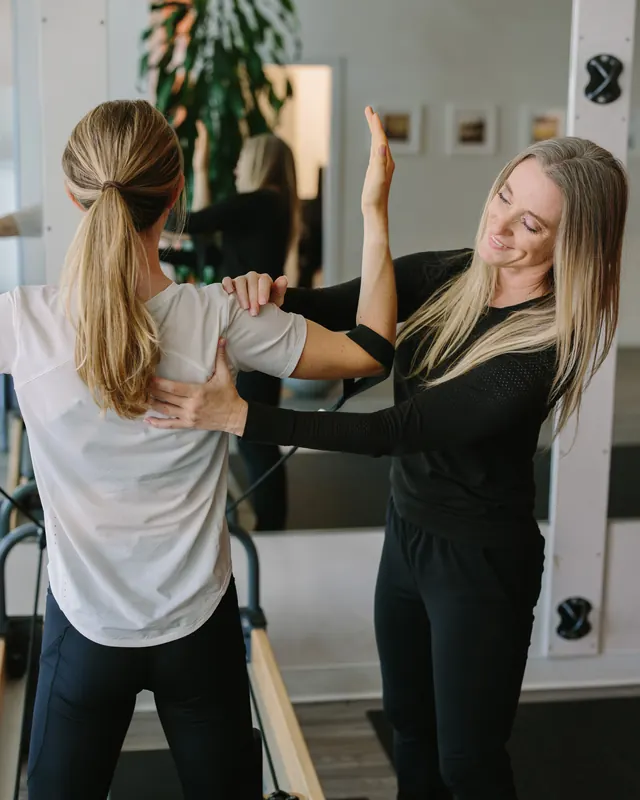
What dance physiotherapy involves
Great dancing takes more than flexibility. It takes strength, stability and endurance. We treat dancers at every stage, from recreational students to pre-professional performers, with assessments tailored to dance technique rather than generic workouts. Treatment and exercise then address how your joints and muscles handle the demands of your choreography, to ease pain, avoid unnecessary time off and get you back to class and performance with confidence.
Range with control
Assessment looks at how well you control the range you have, not just how much you've got.
Built around your schedule
Class, rehearsal, and performance loads all factor into the plan.
Foot and ankle focus
A common source of dance injury, assessed in detail.
Readiness for pointe
Moving up to pointe is an exciting milestone, and it needs a strong, stable foundation. Many studios ask for a physiotherapy assessment before a dancer starts. We look at foot and ankle strength and stability, lower body strength and overall alignment, to see whether your body is ready for the demands of pointe work. If it isn't yet, we build a targeted conditioning program to help you get there and step into your first pair of pointe shoes with confidence.
Jill Renowitzky does our pointe readiness assessments. Book a physiotherapy appointment with Jill and mention pointe readiness when you book.
Common reasons dancers come in
Pointe readiness
Checking you're ready before your first pair of pointe shoes.
Foot and ankle pain
Symptoms through the foot, ankle, or Achilles.
Hip pain or clicking
Discomfort or catching through the hip with range work.
Low back pain
Symptoms with extension work or repeated loading.
Returning after injury
Getting back to full class and performance load safely.
Questions from dancers
Is hip clicking during dance something to worry about?
Painless clicking is common and often not a problem. Clicking with pain, catching, or a loss of control is worth assessing. We can help identify what might be causing your symptoms.
Will I have to stop dancing?
Not necessarily. Modifying load is usually more workable than stopping, and what that looks like depends on your assessment. The exception is deep groin pain that keeps building with jumps, especially if walking hurts or you limp. It can be a bone stress injury near the hip: stop dancing, keep weight off that leg and see a doctor today.
Do you work with dancers at all levels?
Yes, from recreational classes through to pre-professional and professional training.
Do you look at fuelling and recovery too?
Yes, where it's relevant. Sleep, eating enough for your training and changes in your periods can all affect bone health and recovery. Our naturopathic doctor, Dr. Katrina Allison, ND, works with active women, dancers among them, on exactly this, including relative energy deficiency in sport (RED-S).
How long before I can get back to full class?
That comes down to the injury and your schedule, and a graded return to class and rehearsal is usually better than a full stop followed by a sudden restart. Your physiotherapist will map out that progression with you.
Is physiotherapy for dancers covered by insurance?
It's a physiotherapy appointment. It bills as physiotherapy. We direct bill most major insurers. Every plan is different. For plans we direct bill, we can check your coverage before your appointment.
Who you'll see: one of our physiotherapists, in a one-on-one physiotherapy appointment.
Related services: Clinical Pilates, Sports Injury, Kinesiology, Naturopathic Medicine.
Get back to dancing
Choose your appointment and book online. What to expect at your first visit
Book now